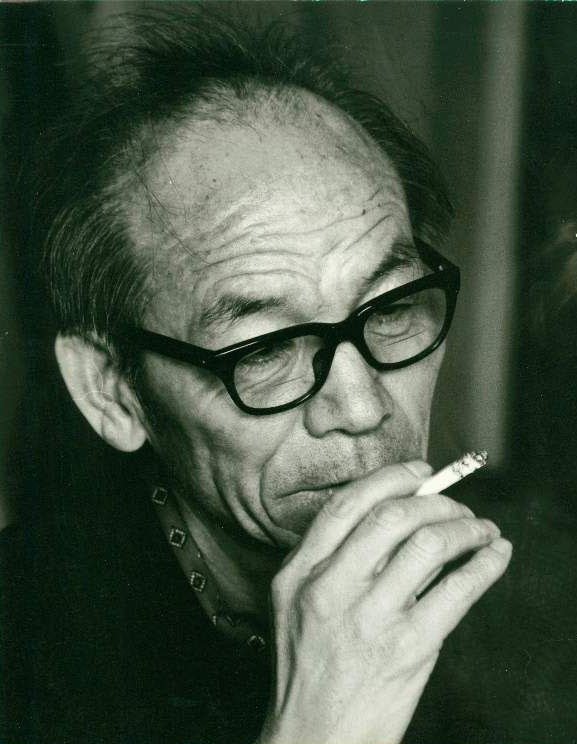
His father’s room
Bae Dong-shin 裵東信
1920 – 2008 · Watercolourist
If oil painting can be likened to eating meat, watercolour is a vegetarian diet. Where oil painting stages dynamic, dramatic emotion, watercolour conveys a fresh and quiet beauty. — Bae Dong-shin, in an interview
A pioneer of Korean watercolour
A Lifetime of Watercolour
Born in Songjeong, Gwangju, in 1920, he went to Japan at seventeen to study painting. In 1943 he graduated from the Western Painting Department of Kawabata Art School and, the same year, won a prize at the Japan Free Art Association exhibition with “Girl”, setting out on the path of a painter.
Returning home after Liberation, he held to watercolour alone for the rest of his life — at a time when everyone painted in oil and watercolour was regarded as little more than a sketch for oil painting. He held twenty-six solo exhibitions and served as the first president of both the Watercolour Creators Association and the Korea Watercolour Association, raising watercolour to a genre of painting in its own right. Influenced by the School of Paris and refined through Japanese painting, he is regarded as having created a rare style in which East and West meet.
He mainly painted nudes, fruit baskets, harbours and mountains, and was especially fond of Mt. Mudeung in Gwangju. Working almost entirely in watercolour, he used a large brush and swift strokes, transforming his subjects through bold omission and enlargement, and expressed movement and volume through a free use of line.— Encyclopedia of Korean Culture, “Bae Dong-shin” (translated)
In 1989 he moved to Yeosu, where he painted the sea and boats of the southern coast to the end. He received the Order of Cultural Merit in 2000 and died in Yeosu in December 2008. His works are in the collections of the National Museum of Modern and Contemporary Art, Korea, and the Ueno Museum in Tokyo.
Selected works
People, Mountains and Sea, Fruit on a Tray
People — self-portraits and portraits
Mountains and sea of the south
Still life and nudes
Certified works
Gazing at One Place
What is particular about Dongshin’s work is the narrowness of its subjects and the absence of technique: mountains, the sea and boats, fruit on a tray, female nudes in the same pose, self-portraits and portraits of women… Gazing at a single spot in the landscape of the southern provinces, Dongshin never stopped using a free composition that ignored technique as bait to reel in the true form of painting. — “Dongshin’s World of Work”, official Bae Dong-shin site (translated)
Works whose large images survive can be clicked to view. Certificates are published on Art & Cult ↗.
Critical voices
Words That Remember Him
In the barren field of Korean watercolour, Bae Dong-shin’s presence is absolutely essential.
A mad obsession with painting
Korea’s foremost watercolourist
An absolute presence in Korean watercolour
As a world-class watercolourist, he helped elevate watercolour — long regarded as a mere underdrawing for oil painting — to a genre of painting, and devoted himself to the development of the art scene in the regions.
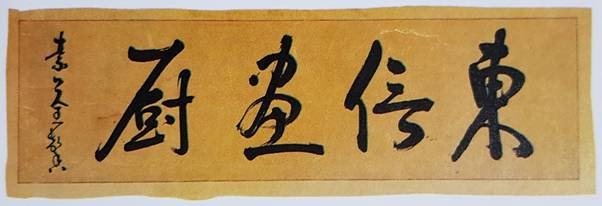
東信畵廚 · Dongshin Hwaju
“Dongshin’s picture kitchen” — a signboard calligraphed for Bae Dong-shin by the calligrapher Sojeon Son Jae-hyeong.
Videos
Bae Dong-shin on Film
Chronology
Chronology of Bae Dong-shin
Father and son
In July 2023, the father’s watercolours and his son Hooranky’s digital art hung together at the Korean YMCA in Japan in Tokyo, where the 2.8 Declaration of Independence was proclaimed in 1919 — twentieth-century watercolour and twenty-first-century digital art in a single room. Read more →
The story of his father’s life, written by Hooranky, can be read on the official Bae Dong-shin site ↗.